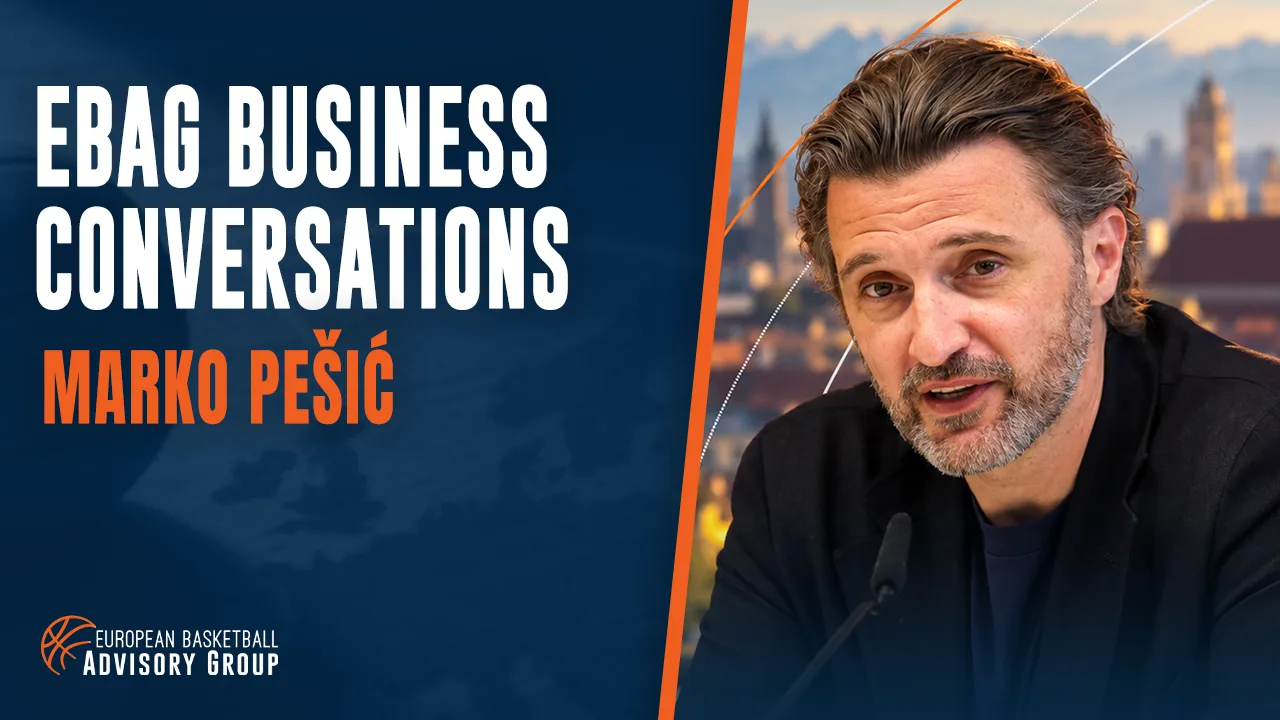
One of the most experienced executives in European basketball, Marko Pešić has built a distinguished career spanning professional basketball and sports management. As a player, he competed at the highest levels of German and European club basketball, represented the German national team and gained international experience before transitioning into management. At FC Bayern Basketball, he progressed through senior leadership responsibilities, including Sporting Director, Managing Director and CEO, spending almost 15 years helping transform the club into an established EuroLeague organization with strong institutional, commercial and operational foundations.
In our conversation, Pešić reflects on the development of FC Bayern Basketball, from the original vision of Uli Hoeneß to the influence of Herbert Hainer and the challenges of building a sustainable basketball business within one of the world's most successful football clubs. We discuss governance, sponsorship, financial sustainability, organizational development and the economic importance of modern arenas, including SAP Garden.
Looking beyond FC Bayern, Pešić shares his perspectives on the structural and commercial challenges facing German and European basketball. We explore financial discipline, league governance and the opportunities to translate Germany's international sporting success into greater commercial relevance. He also reflects on his early experiences around the legendary Yugoslav basketball generation and the importance of preserving European basketball's unique identity and traditions.
Drawing on decades of experience on and off the court, Pešić offers valuable insights into the leadership, investment and long-term strategic thinking required to build sustainable basketball organizations and strengthen the future of the European game.
A new chapter at FC Bayern
EBAG: After almost 15 years building and leading FC Bayern Basketball, you stepped away from the operational management of the club at the end of 2025 and remained connected to FC Bayern in an advisory capacity. More recently, the Präsidium nominated you to succeed Mr. Walter Mennekes as 2nd Vice President of FC Bayern München e.V., subject to confirmation by the members at the November General Meeting. First of all, congratulations. What has life looked like since leaving the day-to-day management of the basketball organization, and what does this new opportunity at the level of the overall club mean to you? Do you see lessons from building FC Bayern Basketball that can be transferred to other sports within such a large multi-sport organization?
Marko Pešić: First of all, I am very grateful for the trust that the Präsidium has placed in me by nominating me for this position. At the same time, I have a lot of respect for the process. Ultimately, it is the members of FC Bayern who will decide at the General Meeting on November 21. Until then, I don't think it would be appropriate for me to speak too much about a possible future role or about what I would want to do in that position.
What I can say is that the past months have given me the opportunity to look at sport and the sports business from a different perspective. After almost 15 years of being responsible for FC Bayern Basketball on a daily basis, stepping away from operational management was obviously a major change. I have been able to work on different projects, meet people from different areas of sport and business, and at the same time remain connected to FC Bayern.
One lesson from basketball that I believe applies far beyond basketball is that sustainable success is never only about the team on the court. It is about people, structures, culture, infrastructure and clear responsibilities. That was one of the central lessons of our development at FC Bayern Basketball. We did not only try to build a successful basketball team. We tried to build an organization capable of sustaining success. I believe that principle is relevant for any professional sports organization.
Rebuilding basketball at FC Bayern and Uli Hoeneß' vision
EBAG: When FC Bayern decided to seriously re-establish itself in professional basketball, the sport was not entirely new to the club. Bayern had already enjoyed significant basketball success decades earlier, but the modern project effectively required building a professional organization almost from scratch. What triggered the decision to invest seriously in basketball again, and what was the original long-term vision? Was the objective initially promotion to the Bundesliga, or was there already an ambition to become a permanent force in German and eventually European basketball? Mr. Uli Hoeneß was one of the key figures behind this project. What was his vision for basketball, and did the strength of his conviction ever surprise you given that his entire professional background was rooted in football? How important was his personal support in establishing basketball within FC Bayern?
Marko Pešić: I think it is important to remember that basketball was not new to FC Bayern. The club had a basketball tradition and had been successful in the 1950s and 1960s. What happened in 2010 was the decision to bring professional basketball back and to build something sustainable for the future. One of the most important decisions was to ask the members. More than 23,000 participated in the survey and over 75 percent supported the professionalization of basketball. That gave the project legitimacy from the beginning.
But there was another principle that became just as important: after an initial investment, basketball had to develop its own economic basis. We could not simply rely on football to finance us every year. In retrospect, this was one of the most important decisions because it forced us to build structures, generate revenues and take responsibility for our own development. Promotion to the Bundesliga was obviously the first sporting objective, but it was never the final ambition. When FC Bayern decides to do something, the expectation is always to compete at the highest possible level.
Uli Hoeneß was extremely important in this process. His strength was not that he came from basketball. His strength was that he understood professional sport, people and institutions. He gave the project credibility and opened doors, but he also expected us to take responsibility. There is one sentence from that period that describes his attitude very well: if we do it, we do it properly. That mentality shaped the project for many years.
Leveraging one of the world's strongest football brands
EBAG: Building a basketball organization under the umbrella of one of the world's most powerful football clubs creates opportunities that almost no independent basketball club possesses. How deliberately did you try to leverage the FC Bayern football ecosystem in building the basketball business? Was there an explicit strategy to use the club's brand, membership base, media reach and commercial relationships, including the visibility created by football players such as Bastian Schweinsteiger regularly attending games, or was the objective from the beginning to establish basketball as a product capable of standing on its own?
Marko Pešić: Of course we used the strength of FC Bayern. It would have made no sense not to. The brand gave us credibility from day one. It gave us access to sponsors, media, members and people who perhaps would not normally have watched basketball. When players like Bastian Schweinsteiger came to our games, that created attention that an independent basketball club would have found very difficult to generate. But we understood quite early that this could only be the starting point.
The FC Bayern brand can bring somebody to a basketball game for the first time. But basketball itself has to convince that person to come back for the second, third and tenth game. So, our objective was always both: to benefit from being part of one of the strongest sports organizations in the world while developing a basketball product with its own identity, audience and economic value. Over time, this became increasingly important. We wanted people and companies to associate FC Bayern Basketball not only with the football club but also with a certain basketball experience, culture and quality. I would describe it very simply: football gave us access. Basketball had to create relevance.
Sponsors: buying FC Bayern or buying basketball?
EBAG: FC Bayern already had relationships with some of the world's largest companies and sports brands when the basketball project began. When you approached sponsors, what were they actually buying? Were companies primarily attracted by the opportunity to extend their relationship with the FC Bayern brand, or did basketball gradually develop a sufficiently distinct audience and commercial proposition for companies to invest specifically because of basketball? And how important is that distinction if the basketball operation ultimately wants to demonstrate that it can sustain itself economically?
Marko Pešić: In the beginning, the FC Bayern brand was obviously an important part of the commercial proposition. We should be honest about that. For many companies, the first conversation was easier because FC Bayern was already a globally recognized brand. But if that remains the only reason for a sponsor to work with you, you have not built a sustainable basketball business. Our job was therefore to create additional value specifically through basketball.
Basketball offers companies a different environment. The proximity to the court and the players is different. Hospitality is different. The audience can be different. The atmosphere is different. And because basketball is an indoor sport with many breaks and many points of interaction, there are also very interesting opportunities for activation and entertainment. Over the years, we increasingly had partners who were interested in exactly those characteristics.
For me, the important question was always: are we creating commercial assets that have value because of basketball itself? That is an important test of economic independence. The stronger the answer becomes yes, the less dependent you are on simply borrowing value from the football brand.
Herbert Hainer and professionalizing the organization
EBAG: You have described the arrival of Mr. Herbert Hainer as the beginning of another phase in the development of FC Bayern Basketball, when the experiences of the start-up years were increasingly translated into structures, processes and longer-term planning. What did you personally learn from Herbert Hainer after his long career as CEO of adidas? Did his experience materially influence the way you thought about strategy, organization, brand building and management within the basketball operation? More broadly, does European basketball need more management expertise from outside the traditional basketball environment?
Marko Pešić: Mr. Hainer came into the development of FC Bayern Basketball at an important moment. The first years had been very entrepreneurial. We were building almost everything at the same time and many decisions had to be made quickly. But an organization cannot remain a start-up forever. At some point you have to transform experience into structures.
I learned a lot from Mr. Hainer, particularly about long-term thinking, brand management and the importance of clear organizational structures. Coming from his experience as CEO of adidas, he naturally looked at certain questions differently from people who had spent their entire lives in basketball. One important lesson was that growth requires processes and responsibilities. An organization cannot depend permanently on a few individuals knowing everything and deciding everything.
At the same time, I also believe there is a limit to what sport should copy from traditional business. Sport has its own dynamics. Decisions sometimes have to be made very quickly, emotions matter and sporting performance creates pressures that do not exist in normal companies. European basketball would benefit from more management expertise from outside the sport. But those people must first understand sport before trying to change it. Sport can learn a lot from business. It should not simply copy business.
The governance model
EBAG: The professional basketball operation is organized through FC Bayern München Basketball GmbH, while FC Bayern München e.V. remains its sole shareholder. From a governance perspective, how well did this model work? How did you define the respective roles of the shareholder, the Präsidium and the management of the GmbH, particularly when it came to budgets, strategic investments and sporting risk? What does good governance look like for a basketball organization in which management needs sufficient entrepreneurial freedom while remaining accountable to its shareholder?
Marko Pešić: For me, good governance begins with clarity. The shareholder must define the overall framework, the strategic direction and the level of risk it is prepared to accept. Management, however, needs sufficient freedom within that framework to operate the business and make decisions. If every operational decision has to go back to the shareholder, management cannot really manage. On the other hand, entrepreneurial freedom without accountability is equally problematic.
Our structure developed significantly over the years. The basketball business was transferred into FC Bayern München Basketball GmbH in 2014, with FC Bayern München e.V. as the sole shareholder. This created a clear institutional framework while keeping basketball completely within the FC Bayern family. Budgets were obviously an essential part of that relationship. Once a budget and strategic direction are agreed, management must take responsibility for delivering against them. Major long-term investments are different and naturally require close alignment with the shareholder.
Sporting risk is particularly important. Every club wants to win, and the temptation is always there to solve sporting problems by spending more money. Good governance has to protect an organization from allowing short-term sporting pressure to become long-term economic risk. For me, governance is therefore not about controlling every decision. It is about knowing who is allowed to make which decision and who is accountable for the result.
Can an elite basketball club really finance itself?
EBAG: FC Bayern has consistently communicated the principle that basketball should operate sustainably rather than simply being permanently cross-subsidized by football. How realistic is genuine financial independence for a EuroLeague basketball club today? Can a club compete at the highest European level predominantly on revenues generated by basketball itself, or does the current economic model still require substantial shareholder or benefactor support? Where should the line be drawn between legitimate strategic investment and permanent structural subsidization?
Marko Pešić: This is probably one of the fundamental questions facing European basketball. If we look honestly at the EuroLeague today, many clubs are not completely financed by revenues generated by basketball itself. Different models exist: shareholders, private owners, large multi-sport organizations or other forms of institutional support. I don't think strategic investment is a problem. Quite the opposite. Sport needs investment to grow. But I make a clear distinction between investment and permanent structural subsidy.
Investment should create something that improves the future economics of the organization: an arena, infrastructure, a stronger commercial organization, technology, youth development or another asset that can generate future value. If an owner simply covers the same structural deficit every season, that is a different model. At FC Bayern, our philosophy was always to increase the revenues generated by basketball itself and build an organization that was as economically sustainable as possible.
We also have to understand that some of Europe's biggest basketball clubs are part of much larger multi-sport organizations, often with football as their primary activity. In such structures, basketball revenues and expenses are not always clearly separated from those of the overall club. This makes it difficult to assess the true economics of basketball as an independent business. A sustainable model requires greater financial separation and transparency. Another important factor is infrastructure investment. At FC Bayern, we invested significant eight-figure amounts in infrastructure and organizational development over the years. These investments may reduce short-term financial results, but they create the foundation for future revenues. Simply looking at annual profits or losses without considering such investments does not tell the whole story.
I don't believe European basketball will become fully independent of shareholders or strategic investors everywhere. But the direction should be clear: clubs need to generate a larger proportion of their own economic value. Otherwise, the stability of an organization depends too much on the willingness of one person or institution to continue financing it. Investment should build the future. Subsidy finances the present.
Building the organization behind the team
EBAG: When the modern FC Bayern Basketball project started, the organization was very small, with only a handful of people covering multiple functions. Over time, the club invested substantially not only in players but also in commercial, communications, operations and other front-office capabilities. What was your philosophy behind building that organization? For a club with a limited overall budget, how do you determine the right allocation between the playing roster and investment in the people, systems and infrastructure behind the team? Does European basketball sometimes spend too much on players while underinvesting in the organization capable of generating future revenues?
Marko Pešić: This was one of the strongest convictions I developed during my time at FC Bayern Basketball. When we started, we had only a handful of people in the office. Everybody did several jobs. That is normal in the beginning. But if your ambition is to become a permanent EuroLeague organization, you cannot only professionalize the team. You have to professionalize everything around the team.
There is always pressure to put the next available euro into the roster because the sporting result is immediate and visible. Investing in sales, communications, ticketing, CRM, digital, operations or infrastructure does not necessarily win the next game. But those investments determine what kind of club you will have five or ten years later. Players win games. Organizations build clubs.
Fundamentally, the team is a cost center. It is the commercial organization around the team that must generate the revenues to finance it. That is why I believe three areas will become particularly important for European basketball clubs: venue operations, event management and marketing, and digitalization. Clubs need professionals who can operate and continuously develop their infrastructure, organize and commercialize events, and create additional revenue streams beyond basketball games themselves.
That does not mean the playing budget is unimportant. Without a competitive team there is no product. The challenge is finding the right balance between today's competitiveness and tomorrow's ability to generate resources. I do believe European basketball has sometimes focused too heavily on player budgets when comparing clubs. A club is much more than its roster. The objective must be to build a business that can grow independently of the playing budget. If you develop the right infrastructure and commercial capabilities, you can generate significantly more revenue without necessarily increasing your sporting expenditure at the same rate. That is the real value of investing in the organization behind the team.
One of the things I am most proud of from my time at FC Bayern is therefore not only what happened on the court. It is that the organization behind the team developed from a very small group into a professional structure with more than 70 people. That organization is part of the legacy as much as any championship.
SAP Garden and the economics of arenas
EBAG: The opening of SAP Garden represented another major step in the development of FC Bayern Basketball and addressed an infrastructure question that had accompanied the project for many years. How much can a modern arena fundamentally change the economics of a basketball club? Beyond ticket capacity, where do you see the greatest economic opportunities: hospitality, premium seating, sponsorship activation, fan experience, data, digital engagement or the ability to turn a basketball game into a broader entertainment product? And could FC Bayern Basketball realistically have reached the next stage of its development without solving the arena question?
Marko Pešić: A modern arena can fundamentally change the economics of a basketball organization, but capacity alone is not the decisive factor. An arena is a business platform. You have ticketing, premium seating, hospitality, sponsorship activation, food and beverage, data, digital interaction and entertainment. Most importantly, you can create a completely different customer experience.
For us, infrastructure was a strategic issue from the very beginning. The move into what is today the BMW Park after promotion in 2011 was already fundamental. Without that step, the first phase of growth would not have been possible. And we continued investing in and developing the BMW Park for many years. It became part of our identity and an important business asset. The SAP Garden then opened another dimension, particularly for EuroLeague basketball. It gave us access to a modern arena environment and significantly more opportunities around premium products, hospitality and the overall event experience.
But there is another fundamental issue: who owns or commercially controls the arena and the rights associated with it? Having access to a modern venue is not enough if the club cannot participate in the revenues it generates. At FC Bayern, we do not own the SAP Garden, but our commercial arrangements allow us to develop our basketball business. Without sufficient control over venue-related revenues and commercial rights, the economic potential of even a modern arena remains limited. We can also learn from developments in the United States, where stadiums and arenas are increasingly integrated into much larger real estate projects, including hotels, retail, offices and entertainment facilities. Sport becomes an anchor for a broader commercial development. European basketball needs to think more in these terms and recognize that infrastructure can create economic value far beyond the games themselves.
Could FC Bayern Basketball have continued developing without solving the arena question? Yes, but at some point we would have reached a ceiling. If you want to grow revenues, audiences and the quality of your product, infrastructure eventually becomes decisive. The important point is that an arena should not be viewed simply as the place where the team plays. It is part of the business model.
Financial discipline versus sporting competitiveness
EBAG: You were critical at times of the way club budgets and financial comparisons were publicly discussed in German basketball. At the same time, Germany and France have traditionally placed greater emphasis on licensing, financial controls and economic discipline than some other European basketball markets. Does that discipline ultimately represent a competitive advantage or disadvantage? Can leagues such as the BBL and France's LNB become more competitive internationally while maintaining stricter financial sustainability standards, particularly when their clubs compete against organizations operating under very different economic models? Should European basketball eventually move toward more common financial rules?
Marko Pešić: Financial discipline is fundamentally a strength. A club that spends money it cannot sustainably finance may improve its team in the short term, but it is creating risk for the future. The challenge in European basketball is that clubs compete in the same sporting competition while operating under very different economic models and sometimes very different financial expectations. That can create competitive distortions.
I have always believed that transparency is therefore extremely important. When people compare budgets, they need to understand what exactly they are comparing. Player budget, total personnel cost and total club revenue are completely different numbers. Without common definitions, public comparisons can become misleading. And I think we should also ask what we want to achieve with financial transparency. If one club has developed a much larger commercial organization and generates significantly more revenue than another, the interesting question should not simply be how much more money it has. We should be asking how that organization was built, which investments made the difference and what other clubs can learn from it. Financial information should help us understand and improve business models, rather than merely compare spending power.
Germany has traditionally had relatively strong financial controls. I would not weaken those principles simply to compete with less sustainable models. But in the longer term, European basketball needs more common standards and greater transparency if it wants to become a more mature industry. That will not be easy. We are dealing with clubs in different countries, inside and outside the European Union, with different legal systems, ownership structures and financial regulations. This is one reason why models from American professional sports cannot simply be transferred to Europe. Any common framework must take these realities into account.
Financial rules only make sense, however, if they are clear, measurable and enforceable. The objective should not be to make everybody spend the same amount of money. The objective should be to create a competition in which everybody understands the economic rules under which they are competing.
Why Germany has not converted its economic strength into basketball strength
EBAG: Germany presents an interesting contradiction. It is Europe's largest economy, with a large population, strong corporate sector and significant purchasing power, yet professional basketball remains relatively concentrated in a limited number of successful markets. Why have economically powerful metropolitan areas such as Frankfurt and Hamburg struggled to establish basketball organizations comparable in scale and permanence to leading clubs elsewhere in Europe? What does Munich have that some of these markets have historically lacked: committed ownership, institutional backing, arena infrastructure, management expertise, basketball culture or simply patience?
Marko Pešić: Economic strength alone does not create successful sports organizations. Germany has many large cities, strong companies and significant purchasing power. On paper, therefore, there should be room for more major basketball organizations. But building a club requires several things to come together at the same time.
You need a committed institution or ownership structure. You need professional management. You need an arena. You need commercial partners. You need sporting expertise. You need a connection to the local community. And perhaps most importantly, you need patience.
FC Bayern Basketball had an enormous advantage because there was already a powerful institution behind the project. We had a brand, members, partners and an existing emotional connection with millions of people. But even with all those advantages, it took many years to build the organization. That is why I am careful when people say that a particular city "should" have a major basketball club simply because it is large or wealthy. A market is an opportunity. It is not an organization. Successful clubs are built by people and institutions that are willing to make a long-term commitment.
German basketball: sporting success versus commercial relevance
EBAG: You experienced German basketball first as a national team player and later as one of its most prominent club executives. Germany has meanwhile achieved extraordinary sporting success, while German players have become increasingly prominent internationally. Yet basketball remains comparatively underrepresented in mainstream German sports media and television. Why has this sporting success not translated proportionately into media and commercial relevance? Is the fundamental issue broadcasting, storytelling, fragmentation, scheduling, the dominance of football, the structure of the BBL or something more fundamental about how basketball has positioned and marketed itself? What would need to change for basketball to make the next step from a successful sport to a genuinely mainstream sports property in Germany?
Marko Pešić: German basketball has made extraordinary sporting progress. We have seen the success of the national team, German players taking important roles at the highest international level and German clubs becoming more competitive in Europe. But I don't think the commercial development of basketball has yet fully matched the sporting development. There is no single reason for this.
Football is obviously extremely dominant in Germany, but I don't like using football as an excuse. Basketball has to concentrate on what it can control. We need to become better at telling our stories. We need to make players more visible as personalities. We need stronger local markets, better digital products and more consistent presentation of the sport. But we also need to understand where our audience actually is. I am not convinced that greater exposure on ARD or ZDF should be our primary objective. Basketball has a young audience that increasingly consumes sport through streaming, social media and short-form content. Telekom has built a strong digital platform with MagentaSport, and I believe this is much more relevant to the future of German basketball than simply trying to appear more frequently on traditional television.
We also need more visionary thinking and a better understanding of how to leverage the opportunities already available to German basketball. Look at initiatives such as the LGCY Series, which last summer brought together German national team stars such as Dennis Schröder, the Wagner brothers, Andreas Obst and Isaac Bonga. These players, as World and European champions, have their own audiences and enjoy a level of visibility that German basketball rarely has access to outside national team competitions. Their presence in Germany, particularly during the Bundesliga's off-season, offered a valuable opportunity to promote the sport. I believe initiatives like these also provide valuable opportunities for the Bundesliga to explore partnerships and synergies, leveraging this “star power” to reach new audiences, promote the sport and strengthen basketball’s commercial appeal.
We also have to think about fragmentation. The national team, Bundesliga, EuroLeague, youth basketball and international basketball are all parts of the same ecosystem from the perspective of a fan, even if institutionally they are separate. The challenge is to make basketball easier to follow and its biggest moments easier to recognize.
However, I believe there is also a fundamental governance situation. The composition of the Bundesliga changes through promotion and relegation, making long-term strategic planning extremely difficult. Even with a clear long-term vision and a strong management team, implementing for example a five-year strategy becomes pretty challenging when the composition of the league and its decision-making bodies can change from one season to the next. This puts league management in a particularly challenging position. Individual clubs understandably have different priorities, particularly when their immediate sporting or economic survival is at stake. Reconciling these interests while pursuing a consistent long-term strategy is therefore an enormous challenge for league management, rather than simply a question of management capability. We have seen what long-term strategic decisions can achieve. The introduction of the JBBL and NBBL and the professionalization of youth coaching around two decades ago laid important foundations for Germany's current sporting success. We need the same long-term vision today on the commercial side of basketball.
Sporting success creates attention, but attention does not automatically become sustainable commercial value. You need structures capable of capturing that attention and turning it into fandom. The potential in Germany is significant. But potential alone has never built anything. Basketball has to make itself more relevant every day.
What must European basketball never lose?
EBAG: I would finish with something deliberately more personal. Long before your own professional career, you spent time around the legendary Yugoslav junior generation coached by your father, Mr. Svetislav Pešić, helping during training camps and preparations and living around players who would become some of the defining names of European basketball, including Toni Kukoč and Vlade Divac. Biographical accounts describe you as spending several summers around those junior national-team camps and helping the team in small ways. You have subsequently experienced almost every side of the sport: Yugoslav basketball culture, Germany as a player, the national team, club basketball and nearly 15 years building a modern EuroLeague organization. When you think back to those early years and compare them with the increasingly professional, global and commercial basketball world of today, what is the DNA of European basketball? What from that old basketball world will inevitably disappear as the sport modernizes? And what must European basketball make absolutely sure it never loses?
Marko Pešić: This question takes me back much further than my time at FC Bayern. I grew up around basketball. I saw a generation of Yugoslav players and coaches for whom basketball was not simply a profession. It was a culture. When I think about that period, I remember the knowledge of the game, the importance of teaching, the relationship between coaches and players, the hours spent in the gym and the belief that individual talent had to serve the team.
European basketball today is very different. It is more professional, more international, more commercial and increasingly global. That development is necessary and, in many ways, very positive. Some things from the old world will disappear. Certain informal structures will disappear. The sport will become more data-driven, organizations will become bigger and decisions will become more professional. We should not be afraid of that.
But there are things European basketball must protect. We must protect our coaching culture and player development. We must protect the importance of the team. We must protect the connection between clubs, cities and supporters. And we must protect the different identities that make playing in Belgrade, Athens, Madrid, Istanbul, Kaunas or Munich different experiences.
Europe should learn from the NBA and from American sports business. There is an enormous amount we can learn. But our objective should not be to become a smaller version of the NBA. The strength of European basketball is its own history, culture, rivalries, coaching tradition and emotional connection to clubs.
Modernization is necessary. Commercial growth is necessary. Professionalization is necessary. But European basketball should become more professional without becoming less European. That, for me, is the balance we have to protect.
EBAG: Thank you very much for taking the time to share your experience and perspectives with EBAG. We greatly appreciate your contribution to EBAG Business Conversations and look forward to sharing your insights with the wider European basketball community.