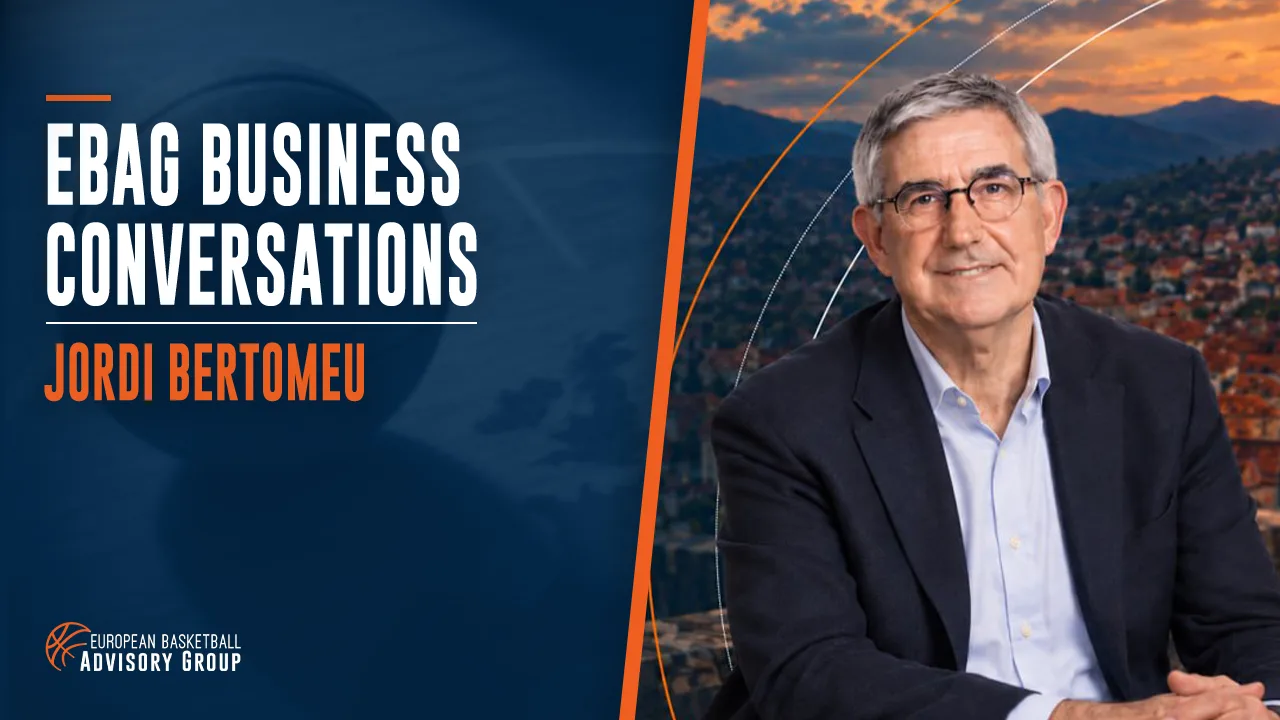
For more than two decades, Bertomeu led Euroleague Basketball, playing a central role in the creation and development of the new club-led competition, its governance model and the broader professionalization and commercial evolution of European club basketball. Before that, he spent 17 years with Spain’s ACB, first as Legal Counsel and Secretary General and later as Executive Vice President.
In our conversation, Bertomeu shares his views on key developments that have shaped European basketball, as well as the business and strategic challenges and opportunities facing the game today and in the years ahead. We discuss Europe’s untapped commercial potential, external investment and club valuations, expansion into new markets and the responsibilities of professional basketball towards the wider ecosystem. We also explore what makes the European game unique, how its identity can be protected and what the emergence of NBA Europe could mean for its future.
The conversation offers valuable insights and lessons from one of the most influential executives in modern European basketball, whose perspective draws on more than four decades of experience at the highest levels of the European game.
Life after EuroLeague
EBAG: After more than 22 years leading EuroLeague Basketball, your departure represented the end of an extraordinary professional chapter. Athletes often get asked what happens the day after they retire. You did not retire professionally, of course, but what was Day 1 like after such a long and intense period? What have you been doing since then, professionally and personally, and to what extent does basketball remain part of your activities today?
Jordi Bertomeu: Honestly, it was not easy to transition to a life in which there were no basketball games every week after 22 years in the Euroleague and the previous 17 in the ACB League. There was a moment of disorientation followed very quickly by the determined will to continue collaborating and contributing to what I am passionate about, which is sport, and to take advantage of the accumulated experience to help new initiatives and projects that were in some way disruptive. This is what I had done in Spain, because the creation of ACB meant a change for all Spanish sport, and later in Europe with the founding of Euroleague. And I have found executive training projects in the university with which I collaborate, and I have created a consulting firm from which I help projects related to sports, whether in the field of management, investments, facilities, events, etc., and among these there are some related to basketball as well.
The original vision
EBAG: Looking back to the creation of the EuroLeague in 2000, what were the fundamental reasons behind the decision to establish a new club competition outside the existing FIBA structure? What were the clubs dissatisfied with at the time, and perhaps more importantly, what was the original long-term vision for the new competition? How much of that original vision do you believe was ultimately realized?
Jordi Bertomeu: Clearly the international club basketball competitions were stagnant; they were not growing from any perspective or metric that we wanted to see. FIBA tried, but without counting on the clubs, because this was their management culture at that time. Any significant change had to come from the clubs, and these were already organized into leagues in most of the relevant countries, and even the leagues of these countries had been organized in the ULEB. There were therefore the experience and the necessary knowledge to change things, dynamize them and grow. We tried to do it with FIBA, but when it was not possible, we did it on our own, under the leadership of ACB, which was, and I think still is, the most professionalized national league in Europe.
The vision was to improve the product, increase the basketball fan base and thus improve the economy. But under the government of the clubs, not of third parties. The clubs are ultimately responsible for the economic result; therefore, uniting decision and responsibility in the same hand was the logical and necessary step for change and progress to occur. And I believe that the successive evolutions of Euroleague until today have maintained these principles.
Clubs as shareholders
EBAG: One of the fundamental characteristics of the EuroLeague model was that leading clubs were not simply participants in the competition but effectively its owners and shareholders. What did you expect from the clubs in that role? Looking back, how successfully did they make the transition from thinking primarily as individual basketball clubs to acting collectively as owners of a European sports business? In areas such as oversight, governance, strategic alignment and long-term decision-making, where did the model work particularly well and where did you see room for improvement?
Jordi Bertomeu: The idea on which a League is based is the management of a collective interest. Clubs have to feel that they own their product. And only in this way are they committed to its improvement and are able to renounce their individual interests for the benefit of the group, such as centralizing the commercialization of rights. The medium- and long-term vision of the whole over the short-term individual vision was the most relevant cultural improvement in European basketball in the last 50 years and also very meritorious, because 75% of the clubs did not come from countries with this tradition of management.
An obvious fact must be highlighted: the clubs were partners and competitors at the same time. In this context, prioritizing the common interest in the face of the urgency of the competition and day-to-day life requires a remarkable effort.
The Euroleague government was characterized by looking at the long term and agreeing with the shareholders/clubs, the strategy and the way to implement it. And it had to be accepted that it was never easy, since each club had its own and different sporting, economic, cultural and even religious context, so looking for formulas that respected as much as possible all sensitivities and preventing anyone from feeling excluded was essential. And I am proud that in so many years, formal votes were rarely necessary.
Not everything is perfect, and it was not. If I had to choose an issue where a collective decision has been more difficult to agree on, it would be the budgetary and financial control of the clubs. And I think that recently we have seen that even today it is a considerable difficulty.
Professionalization and commercial management
EBAG: During your tenure, EuroLeague Basketball introduced several initiatives aimed at increasing the professionalism of clubs beyond the sporting side of their operations. The introduction of CBO roles and initiatives such as BOCS were particularly interesting attempts to strengthen the commercial and business capabilities of clubs. Looking back, how successful were these initiatives? What were the main obstacles to creating stronger commercial structures at club level? More broadly, do you believe European basketball has historically placed too much emphasis on sporting performance relative to the professional management and commercial development of its organizations?
Jordi Bertomeu: It is fair to say that in European sport, concern for sporting results has been the priority in the management of clubs. However, it is also fair to see a change, especially in the last 10–15 years. As you say, in Euroleague we have been implementing many initiatives aimed at improving management through professionalization and sharing knowledge.
In 2009 we created a ticketing program for clubs that was the seed to create BOCS later.
Convincing clubs that the non-sporting area should be as important or more important than the sporting area was not an easy task. But we managed to move from a situation where the non-sporting staff was reduced to two or three people who sold tickets, looked for sponsors and wrote press releases, to a situation like the current one in which business structures, without being ideal, are much more developed, sophisticated and have personal means and budget. However, the insufficient use of technology to improve management is still an obvious weakness. Solving this requires considerable economic investment aimed at providing clubs with the tools that allow them to access data, analyze, segment, create strategies and plan their commercial activity. It requires understanding that the digital area is the commercial asset on which the greatest income will be generated in the future. However, and by contrast, we see that in the sports area clubs are taking more advantage of technology.
Europe's commercial potential
EBAG: For decades, basketball has been described as one of the world's most popular team sports, yet European club basketball has often struggled to translate that popularity into comparable commercial and economic value. Do you believe European basketball still has significant untapped growth potential? If so, where do you see the greatest opportunities for future growth: media rights, sponsorship, ticketing and hospitality, international expansion, digital audiences or entirely new revenue models?
Jordi Bertomeu: Without a doubt, the potential for growth is enormous. Logically, the key is in consumption. It is essential that the Euroleague continues to give priority to protecting the product, the competition.
It is fundamental to think in the medium and long term to make investments and take decisions that facilitate the popularity of basketball, especially in markets not traditionally considered basketball, but which demographically and economically are very powerful. The rush to monetize would not help to achieve this goal.
Secondly, we must insist on the professionalization of clubs. An increasingly sophisticated business requires being up to date and not being afraid of change. It is necessary to identify the business verticals that are less exploited, analyze the causes and make decisions so that clubs can improve their commercial performance. We need talent off the court.
One of the best decisions made by Euroleague was to move to pavilions of 10,000 spectators. Now we must go further, not only in capacity, but in the quality of the experience offered to the fan and the enormous possibilities of monetization that game day offers to clubs.
Without a doubt, sponsorship and DTC are areas in which there is a lot of room for growth, and regarding media rights, the possibilities for growth are surely linked to new competition formats. We already demonstrated this in 2016 when the round-robin format was implemented, which, with some small modifications, is still in force, and UEFA has demonstrated it with its new competition model. And it is public that Euroleague is working on it.
And a transcendental issue will be the expansion and concession of new franchises. It is necessary to make the right choice of markets, the right choice of the clubs and pay close attention to their ownership and governance, since the owners have to be fully aligned with the long-term strategic vision of Euroleague. New clubs must be levers to expand the fan base and increase revenues.
France, Germany and particularly the UK
EBAG: Expanding EuroLeague's footprint in large European markets such as France, Germany and the United Kingdom was an important strategic objective during your tenure. France and Germany have subsequently strengthened their presence, while the UK remains a particularly difficult market for elite European club basketball. What determines whether basketball can establish itself as a major professional sport in a particular country? Why has the UK proved especially challenging And how important can the connection with established football brands be in this context? Was leveraging the enormous brand recognition of organizations such as Real Madrid, FC Barcelona and FC Bayern Munich part of EuroLeague's thinking about growing basketball beyond its traditional audience?
Jordi Bertomeu: As you say, Euroleague has always had the clear idea that basketball should go beyond the traditional markets. Even we were unsuccessful, we must remember that in the first two seasons we had a team in London. Later we incorporated Turkey into the group of top-tier markets and shortly after I went to invite Bayern Munich before they were promoted to the German first division. France always had tradition, although without sports results at the club level.
But I agree with the analysis. Progress has been made in France and Germany, but not in the UK. Nor in the Scandinavian countries. And Italy does not have the weight it always had in European basketball.
The causes depend on each country, but it is clear that the UK is a very saturated market and requires an ad hoc strategy, with a clear vision in the medium and long term, and an action and investment plan that places Euroleague within the entertainment offer for the British. The fact that there is no relevant local competition undoubtedly adds difficulty. A joint strategy could be something to consider.
It is obvious that the most powerful brands in sports benefit basketball when we manage to incorporate them. Bayern Munich is a clear example of how it helps the growth of basketball in Germany. As Fenerbahçe was in Turkey previously. Replicating this model in the UK was tried years ago, but we were unlucky. It is the brand, its huge social base that transcends its natural territory, the diversity it brings. In short, there are many benefits to this partnership.
External investment
EBAG: There were already discussions during your tenure about bringing external capital into European club basketball, including contacts with potential investors and discussions in the United States. What type of investors were interested in at the time, what did they see in EuroLeague and what ultimately prevented an investment from taking place?
Looking at the considerable investor interest surrounding European basketball today, including the NBA Europe project, do you recognize similarities with the investors and investment logic you encountered at that time, or has the investment proposition fundamentally changed?
Jordi Bertomeu: The current scenario is radically different from the one that existed at the beginning of the decade. At that time, financial resources were sought, regardless of the way in which they were structured, aimed at improving a very specific area: the digital area. I have already mentioned the weakness of clubs in this area, and I would now add that it is difficult to improve if we do not act from the collective, from the Euroleague, because the clubs cannot in many cases access the necessary resources to face this effort.
Today there is talk of ownership, of the clubs and even of the League. There is talk of commercial platforms that are structured to accommodate financial partners in the hope that this alliance will help generate more resources for the clubs, even if they have to share them with their partners. I think the idea is valid if some conditions are met. The first is that the investment is used to generate new resources or to improve current ones. The second is that the governance of the League guarantees the absence of any type of conflict of interest, so that the competition is fully shielded. Here it will be argued that there are sporting decisions that have an impact on the business. It is obvious. This has been the case from 2000 until today. But the integrity of the competition has never been discussed or questioned.
Valuations
EBAG: Recent discussions around new European basketball projects have included potential franchise valuations ranging from $500 million to $1 billion. From your experience building and commercializing European club basketball, how should we think about the economics underlying valuations of that magnitude? If such valuations can be justified, what are the principal value drivers an investor would need to assume in terms of future revenues, market growth, media rights, scarcity or strategic value? And if today's underlying economics do not yet support them, what is the market effectively pricing in?
Jordi Bertomeu: In my opinion, valuations of the level you mention do not correspond to the reality of basketball in Europe. If it were feasible, the first consequence would be an almost general replacement of the current owners of the clubs by new owners, the investors. It is obvious that the current clubs do not have the capacity to assume those valuations. And it remains to be seen whether football clubs are willing to make investments of this level for the basketball sections.
If the answer is that the investment will be profitable in the very long term, we must remember that sport is very dynamic and the sports industry also changes easily, so making forecasts for such a long period involves a lot of unpredictability.
Responsibility for the wider basketball ecosystem
EBAG: Should Europe's leading professional club competitions have responsibilities that extend beyond organizing an elite competition and maximizing their own commercial value? In particular, should they contribute directly to grassroots basketball, youth development, coaching, officiating or participation? If so, what could an effective model for sharing responsibility and resources across the basketball ecosystem look like?
Jordi Bertomeu: We must be clear on this point. Clubs already have an enormous responsibility in the development of basketball. In Europe, the vast majority of players come from clubs and mainly from clubs consolidated in the European national leagues. The enormous work they have been doing for decades is not recognized.
That said, the Federations are the main responsible for these areas. Some are actively working to create the optimal conditions to generate good players, coaches and referees. And in my opinion, the professional leagues should collaborate with the Federations, based on programs that have clear objectives, and an action and budget plan that covers the needs and is managed with total transparency.
What is uniquely European?
EBAG: Having spent more than two decades building a pan-European competition, what do you believe is genuinely unique about European basketball? What is its USP, not only as a sporting product but also culturally, socially and economically? And which elements of that identity should be considered assets that European basketball must protect rather than obstacles to commercialization?
Jordi Bertomeu: Definitely, the fans. Identification with colors and a symbol has a unique emotional charge. As is the way it is manifested. The experience of attending a Euroleague game is indescribable by sport lovers, regardless of what happens on the court.
Secondly, the game. Based on a non-negotiable collective principle, which does not exclude; on the contrary, it promotes its stars.
And thirdly, the technical excellence of the players. The work of generations of coaches focused on individual technique, understanding the game and tactical deployment are three elements that have made up a unique style of basketball.
Passion, team, excellence, are three arguments to build a storytelling of a commercial campaign.
Protecting European basketball's identity
EBAG: As European basketball seeks greater investment, commercial growth and international relevance, do you believe it will manage to modernize without losing the identity, heritage and sporting culture that made European basketball distinctive in the first place?
Jordi Bertomeu: I am not unaware that it can be a risk. But this should not prevent us from looking forward. Basketball was a niche sport for decades in the last century. The changes and the risks associated with the changes have led it to be global. What must be done is to ensure that the European basketball "brand" is protected, as all brands are.
The next five years
EBAG: European basketball is entering another period of potentially fundamental change: increasing outside investment, changing club valuations, NIL and new pathways for young players, continued globalization of talent and now the prospect of NBA Europe. If we speak again five years from now, what do you believe the European basketball landscape will most likely look like?
Jordi Bertomeu: I think it's very difficult to make predictions. Or at least to make them without confusing it with your own desires. There are many challenges, as you say. Euroleague was disruptive 26 years ago and now no one questions it. Basketball has adapted to the new reality generated by Euroleague and its unthinkable changes in years before, such as not accessing the competition from national competitions.
The future will bring us the same situation, but first we will have to find a solution to the training of talent, today at obvious risk. And something more is required than saying "those who leave will come back." The problem is not that they return, but the problem is that if no one leaves anymore because production has stopped.
I don't think we can go backwards in globalization. The NBA promoted it a long time ago and today we live with it, knowing that the markets are global. And perhaps this has led to the NBA Europe project; it is its natural evolution. In any case, it seems to me not very feasible today and under the conditions described.
I believe and hope that Euroleague will continue to grow, that it will be present in more countries, that it will increase its fan base, that it will continue to generate sporting talent and improve the competition, that the business will grow based on management where talent and professionalization are the priority and, in this way, achieve the sustainability of the clubs. And in this context, that the largest basketball organizations worldwide cooperate would be great news.
EBAG: Thank you very much for taking the time to share your experience and perspectives with us. We greatly appreciate your contribution to EBAG Business Conversations and look forward to sharing your insights with the wider European basketball community.