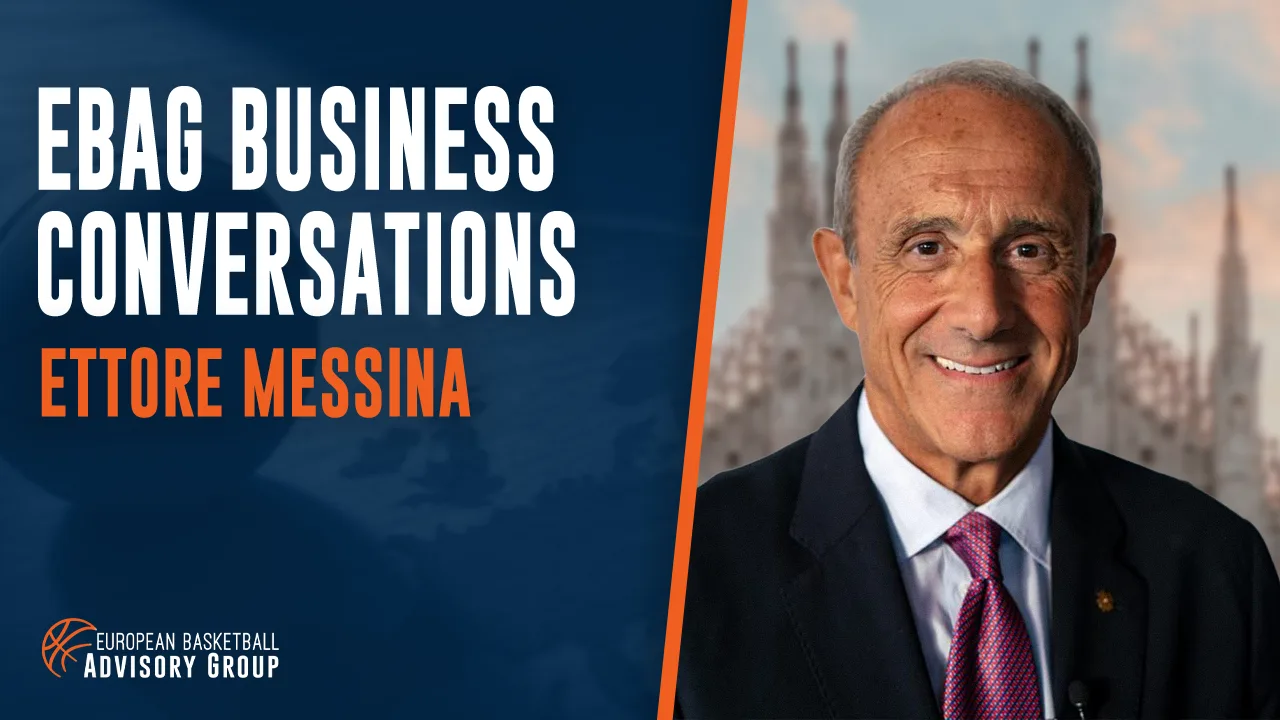
One of the most accomplished and respected figures in international basketball, Ettore Messina has built an extraordinary career spanning European club basketball, national teams and the NBA. A four-time EuroLeague champion and FIBA Hall of Famer, he has coached some of Europe's most prestigious clubs, led the Italian National Team and served as an assistant coach with the San Antonio Spurs. Most recently, he served as Head Coach and President of Basketball Operations at Olimpia Milano before joining the Atlanta Hawks as Coaching Consultant.
In our conversation, Messina shares his perspectives on the structural, financial and strategic challenges shaping the future of European basketball. We discuss competition models, governance, competitive balance, financial sustainability and the potential implications of NBA Europe. Drawing on his experience on both sides of the Atlantic, he reflects on what European basketball can learn from the NBA while preserving its unique identity and passionate fan culture. We also explore the importance of arenas and commercial infrastructure, the role of major football clubs and domestic leagues, and the growing challenges facing youth development in the age of NIL.
Messina also reflects on his years at Olimpia Milano and the legacy of Giorgio Armani, offering personal insights into the passion and values behind his long-standing commitment to the club. His experience as both coach and executive provides an additional perspective on club leadership, organizational structures and the relationship between sporting ambitions and financial realities.
Bringing together decades of experience at the highest levels of international basketball, Messina offers a thoughtful perspective on the challenges, opportunities and decisions that will shape the future of the European game.
A new chapter in Atlanta
EBAG: First of all, congratulations on your new role with the Atlanta Hawks, working alongside Coach Quin Snyder. What attracted you to this opportunity, what will your role look like, and what continues to motivate you after so many years in basketball?
Ettore Messina: First of
all, I was looking for something that would allow me to continue working in
basketball while waiting for a new opportunity to coach. I kept my position as
president of Milano for six months, until the end of the season, and I know
that perhaps gave the impression that I might want to retire. Honestly, I did
not have a clear mind at that moment. During the summer, while travelling
around Europe to give clinics, I realized that I missed the court. I wanted to
stay on the court and, hopefully, coach again if the right opportunity presents
itself.
It was also important for me to have the opportunity to work with Quin Snyder. He is a friend and we worked together with the Lakers and in Moscow, where he was my lead assistant. I also know and trust the people in the organization, so I feel I am with the right people, which is the most important part. My role is very simple. I am a consultant. I attend practices and meetings, watch games, talk with the coaches when they ask, give my opinion and keep learning. We have already planned around five visits of two or three weeks each. The truth is that it has been impressive to be back in the NBA after seven years and see the level of knowledge, organization and professionalism, and the way practices are structured. It has been really impressive to see how they continue to move forward.
The ideal European competition modelEBAG: If you could design European basketball from scratch today, what would the ideal competition system look like? How open or closed should it be, and what mechanisms such as trades, salary controls or revenue sharing would you introduce to improve competitive balance and financial sustainability?
Ettore Messina: The issue of trades and similar mechanisms is, in the end, procedural. First there is a matter of philosophy. Right now, in sports, as in politics and in the rest of the world, ideas are too often evaluated depending on who they come from rather than on whether they could benefit the whole ecosystem. Everybody says we cannot continue like this: too many games, too many competitions, a completely overloaded schedule and significant financial losses. Everybody knows the disease, but when we start talking about the treatment, nobody is willing to move one step.
If I could design the system, I would dream of one major competition that also respects the national leagues, with some possibility of access for teams coming from those leagues, so not a completely closed system. I also think there should be some level of cooperation with the NBA because of its tremendous business and financial power, ability and knowledge, from which we can only benefit. We also need space for the national teams because people in each country love their national teams, and we need to protect the bodies of the players. Another crucial issue is the player pipeline. We need more good players to be available to the market. Otherwise, good players become an increasingly scarce resource and clubs inevitably fight for them and overpay for that scarcity. We have to consider NIL, the NBA's demand for players and the possibility of future NBA expansion. If the NBA launches its own league in Europe without an agreement with the EuroLeague, while the Basketball Champions League also continues, fragmentation will become an even bigger problem. We need to find a balance.
Finally, we need to decide whether the top European competition wants to give every club a realistic chance to win or whether success will remain concentrated among the clubs with the biggest budgets. In Europe, more or less the same teams tend to reach the Final Four and win the EuroLeague. They deserve their success, of course, but the system is different from the NBA, where we have seen many different champions in recent years. We need to decide what we want. Once we decide, we need to build the system accordingly and stick with it.
The ideal governance model for a club
EBAG: Based on your experience both as a coach and executive, what does good governance of a professional basketball club look like? How should responsibilities be divided between ownership, management and the sporting side?
Ettore Messina: First, I want to clarify that I held both the president and head coach positions in Milan because, when I arrived, the club was facing a difficult situation and we agreed that it was important to have one person with broader responsibility. I think we did a good job reorganizing the club, attracting top players and getting the team back on track. Looking back, after the first three years it probably would have been better for me to leave the executive position and continue only as coach. In Europe, I do not think combining both roles for a long period is ideal. We faced a particular situation and, I believe, handled it successfully.
I always remember something the president and owner I had in Bologna used to say: a long team, meaning enough players to face a long season, but a short club, a short management structure. Today clubs are obviously larger, but the principle remains: it is about trust, relationships and communication. There should be open communication between the coach and the owner, but also constant exchange among the owner, the manager and the coach, with each respecting the other's role. The key is working together. Otherwise, you easily create a situation where the coach believes the level of talent provided is not sufficient, while management believes the talent is good enough and the coach is not using it properly. The owner, manager and coach must stay aligned between the reality of the team and reasonable expectations. Once expectations and reality become disconnected, problems begin.
Then there is the business side, which is becoming increasingly important because every club needs revenues. That area can be led by another manager. A crucial issue today is also the ability to own or operate the arena. It is not only ticketing. It is advertising, food and beverage, parking, suites and many other revenue streams. Arena revenues play a major role in NBA business plans and in the ability to break even. Clubs that do not control their arena are simply not in the same position as clubs that own it or have a long-term agreement allowing them to operate it and capture those revenues.
The Armani model
EBAG: Having experienced Mr. Giorgio Armani's long-term commitment to Olimpia from inside the organization, what motivated his investment in basketball? Was it mainly personal passion, or was there also strategic value for the Armani brand and business?
Ettore Messina: First of all, we are talking about one of the great icons not only of the fashion world, but of business in general. We are talking about elegance, leadership, creativity and an extraordinary ability to communicate. I was very fortunate to have the opportunity to work with him and talk to him. My feeling from that relationship is that his main driver was his love for the city. He initially became a sponsor of Milano. Later, when the team was close to bankruptcy, prominent people in the city approached him and asked him to save the club.
There was also a long-standing passion for basketball in the Armani family. Mr. Armani himself had played basketball at some level, and he often spoke about how his love for the game started when he was young, watching his older brother Sergio play on weekends. His sister Rosanna also played basketball at a good level in the 1960s. So basketball was really part of the family. I think this certainly played a role in his decision to take over the club in 2008. But above all, I think there was a sense that he wanted to give something back to Milan. Over time, he became very passionate about the team. He loved the atmosphere and the affection he received from the fans. He never refused a selfie or an autograph. He was very caring about the team and focused on how it played, on the effort and, as he used to say, on playing with elegance.
At times, if he felt the team needed something, he might provide additional budget to give us the possibility to sign another player. But his involvement was really driven by his care for the team and his passion for it. I believe that legacy will remain. I think Mr. Dell'Orco and the family will continue it. At this point, it is very difficult to imagine Olimpia Milano without the Armani family because of the legacy Mr. Armani left, not only through his investment but through his care and passion for the club.
Can European basketball become financially sustainable?
EBAG: Can elite European basketball realistically develop a model in which clubs finance themselves predominantly through the revenues they generate rather than depending on wealthy owners or shareholders? Where do you see the biggest opportunities to close that gap?
Ettore Messina: I think that should be the target. We cannot simply talk about a salary cap in Europe. In the NBA, you first put the revenues into a common pot, including television rights, merchandising and other income, and then determine what percentage goes to the players and what percentage goes to the owners. In Europe, creating that common pot is technically much more difficult because of different taxation systems, different television rights and different markets from country to country. But if we do not create the pot, we cannot seriously discuss how to divide it or how to relate revenues to cost control.
I am not a businessman or a financial expert, but I look at it like a family: first you see how much money you have, then you decide how to allocate it, and you try to contain your costs. Despite the good work that has been done to increase EuroLeague revenues, the cost of players and coaches has increased even faster. That is simply a fact. We can continue like this, or we can target a different model. It is positive that new clubs want to enter the EuroLeague and are willing to pay for licenses. But many of these projects are still associated with a major owner who is financing the ambition.
This also connects to ideas such as trades. I have supported the possibility of trading players, not as a punishment, but as one mechanism that could help make the league more efficient and potentially more profitable. With the increasing scarcity of top players, many teams are rebuilding large parts of their rosters every summer. The more you have to change, the more risk you take. If something does not work in one place, perhaps it could work somewhere else. These are simply possible mechanisms to help make the EuroLeague business more sustainable, especially in the absence of a traditional salary cap.
NBA versus Europe
EBAG: Having worked inside the NBA for several years, what are the biggest structural differences between an NBA franchise and a leading European club? What does the NBA do better, and what should Europe preserve?
Ettore Messina: The biggest difference is that the NBA decided many years ago to create a common economic pie and then determine how that pie should be divided, including with the players. Players have enormous and deserved power because they are the main actors in every competition. They are why people come to the games. They deserve to be rewarded accordingly, but the system also has to remain healthy for the league. You can spend more for two or three years, but if the business eventually goes bankrupt, what will the next generation of players find? The NBA also decided whether it wanted a system in which every team could realistically have a chance to win, and then built rules around that objective. From a business, structural and planning perspective, they made some great decisions.
Europe is trying to catch up in those areas. But our biggest assets are the quality of the games and the passion surrounding them. Sometimes that passion can even become excessive, because after three games everybody is already under pressure, but the competitive level is amazing. There is a great deal of respect in the NBA for what European basketball does technically and tactically. You can see that in the number of European players who have become major NBA stars and in the coaches and executives who are increasingly connected across the two systems. If the NBA and EuroLeague can eventually reach an agreement, one of the most important things will be to preserve the soul of the competition we have in Europe. My hope is that EuroLeague and NBA Europe can find a way to come together around one common league.
Football and basketball
EBAG: Should European basketball make greater use of the brands, infrastructure and commercial power of major football clubs, or does basketball ultimately need to build a stronger independent identity and business model?
Ettore Messina: One important difference between Europe and the NBA is the relationship between fans and teams. In the NBA there is enormous attraction around individual stars such as Steph Curry, LeBron James or Victor Wembanyama. Fans identify with the team, but also very strongly with the great player. In Europe, fans are first of all passionate about their club. There is a unique relationship of love, passion and identity between the fan and the club. Players change, coaches change, but the love for the club remains. That is one of the major strengths of European sports organizations.
At the same time, basketball cannot simply expect football to finance it. That is not a sustainable model. What the major football organizations can bring is enormous experience in operating arenas and stadiums, managing relationships with fans, merchandising, ticketing and many other commercial areas. That know how has tremendous value. It is therefore not surprising that the NBA is presenting its plans to major European football clubs and hoping that some of them will become involved. These organizations are the big brothers in European sport. I do not think there is any shame in basketball maintaining its own proud identity while also working with the NBA or with major football clubs.
Domestic leagues and European competitions
EBAG: What role should domestic leagues play in the future? Can leading clubs realistically continue competing fully in both domestic leagues and European competitions?
Ettore Messina: I do not see domestic leagues disappearing. There is a strong identity in every country around the clubs, just as national teams continue to be important to the identity of European basketball. The pride of wearing the jersey of your national team is important, and the pride of supporting your club against local opponents is important.
The real issue is making the schedule reasonable. If we can reach a better agreement and organization among the different competitions, we can create a more logical number and sequence of games. It is difficult for me to imagine a model in which the top clubs do not play their domestic leagues and simply appear for the playoffs. I think that would be very difficult in the European context.
Youth development and NIL
EBAG: With NCAA and NIL creating increasingly attractive alternatives for young European players, does the traditional European youth development model still work? How can clubs continue investing heavily in player development without an adequate return?
Ettore Messina: Youth development is extremely important. In Italy, we once had a rule requiring clubs to have a strong youth program in order to play in the league. Later that requirement was reduced, and to me that was a real mistake. The system should require top clubs to maintain strong youth sectors, while also recognizing the clubs whose primary activity is recruiting, teaching and developing young players. There must be a reward for the work those clubs do, and the different levels of the development system have to be connected.
The biggest new challenge is the NCAA. It can attract players for little or no compensation to the European clubs that developed them, and NCAA basketball operates outside the FIBA and Olympic structures. At the same time, the NIL environment in the United States is still evolving and remains complicated even there. There is effectively no limit to what some programs can offer. A young player may receive many times what he was earning in Europe.
We cannot prevent players from going to college, and in fact it can also be a very good opportunity. We often complain that at 18 many talented European players have finished their youth career but are not yet ready to play at EuroLeague level. They can end up in a no man's land, sitting on the first team's bench or moving on loan. College can give them a high-level playing and life experience. The difficult question is what happens when they return. Which club has rights? Who developed the player? How should that development be recognized? FIBA is trying to help find some kind of agreement, but it is very difficult, especially while the United States itself is still trying to determine how to regulate the system.
The role of agents
EBAG: Do player agents have too much influence in European basketball today, or does the market need structural changes to create a healthier balance between players, agents and clubs?
Ettore Messina: I do not think it is right to generalize. As in every profession, there are people who are better and people who are not as good, and relationships can be good, average or difficult. I particularly appreciate agents who envision a career path for their players, especially young players, and help them understand that sometimes it is worth sacrificing some money in the short term in order to gain the right experience, at the right level, with the right team and organization, and create better opportunities in the future.
One change I would like to see is that, as in the United States, agents should have to choose whether they represent coaches or players. I do not think it is right for the same agent to represent both because it can create a potential conflict of interest.
Rules and enforcement
EBAG: Beyond designing the right rules for European basketball, how important is the ability to enforce them consistently across different countries and legal systems?
Ettore Messina: There is a broader issue beyond deciding what rules or systems we would like to introduce: once we agree on a rule, how do we enforce it? The recent Ballmer case in the NBA, related to an alleged irregular circumvention of the salary cap, is an example of the kind of situation that can be investigated and addressed within one established league system. I think something similar would be extremely difficult to detect and address in Europe because there are so many different legal, tax and contractual environments. That is one of the biggest challenges for European basketball: not only creating the rules, but making sure those rules can actually be enforced.
European basketball in 2035
EBAG: Finally, looking ten years ahead, what would success for European basketball look like to you?
Ettore Messina: It will be a success if we have a good, strong league with, in my opinion, cooperation between EuroLeague and the NBA; if more clubs own or control their arenas; and if we have more games on television. If those three things happen, they will probably also mean that the teams are becoming profitable.
EBAG: Thank you very much for taking the time to share your experience and perspectives with us. We greatly appreciate your contribution to EBAG Business Conversations and look forward to sharing your insights with the wider European basketball community.